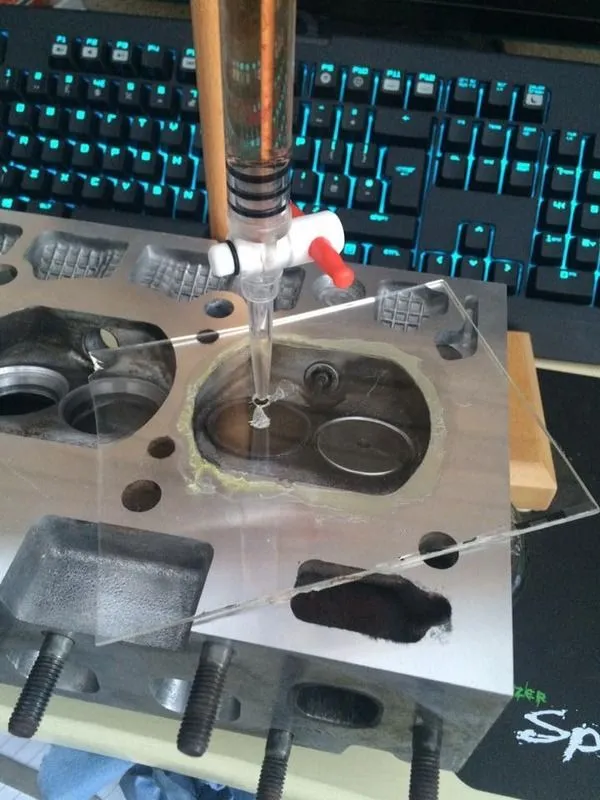
Thought I’d upload photos on here, wont be much fluffy writing just parts and photos
Whacked a T28 on my car and run 25psi for a bit needless to say it was very enjoyable but engine that was built 4 years ago didnt like the extra strain and wear.
So cracked some inlet collets, valve collet grooves worn massively rocker arms worn away, bent cylinder 4 rod (piston down 1mm than rest)
With all the above happening… it was time for forged
77mm Ductile liners
77mm Wossners
Pec rods
Liner height checking = 0.0mm
renault spec 0.04-0.09mm
Sanded block using 80,180,240,500 grit then followed by 800 wet n dry on a very flat long block
Now I have 0.09mm
Basically, yes. I’m not keen on the term “forged” engine personally but usually it implies uprated items such as pistons, liners and rods to make the bottom end stronger but could go as far as a steel crank (megabucks), billet cam, bespoke valves and so on.
But from a C1J point of view, what does it represent in terms of gains ? Being able to cope with an increase in power? 250, 275, 300 ? Or is it more of a reliability play ? Assuming of course that other restrictions do not apply.
Update,
Cleaned the main bearing faces with some old red scrotchbrite, not to remove material only the dirt and surface crude also makes good beer holder
Honed the camshaft bearings in the block as you can see they weren’t in the best shape after 20+ years, Knocked out the blanking plug and the hone tool is perfect length for getting the 2 bearing faces inside middle of the block.
Engine stand handle and microfibre works really well cleaning the holes afterwards even tho its going back into the parts washer to flush the oil ways again ready for engine building
Also ordered a New from blank piper 270 cam…after weighing up what i had before, my goals and advice off someone with quite a bit more knowledge with high bhp c1j engines.
Mark its being built for reliability mostly, the only way you can gain any power from rods and pistons is if the compression ratio changes
I had a choice of the 3 cams, catcam, 285 and 270, I did my own research trolling forums for dyno graphs etc, and then i dropped an email to Chris at efi, the 270 the lower overlap works well then move the cam on the vernier to suit the needs of rpms, which kinda confirmed my ideas that the 285 is too aim’d for peak hp rather than a nice torque curve
And when you consider is have bigger valves a milder cam wont loose me much, what I lost in lift, I gained in port/valve size.
I’ll be making and tig welding up a timing cover which will allow me to adjust the vernier on the dyno
Nope certainly not crossed wires buddy, quote copied straight from my emails
[quote] All the years I’ve been playing with these engines (granted not so much these days) I still wasn’t able to quantify the results from each different cam all that well. For example, some of the most powerful C1J’s have run a very mild cam, the BP270 – making them rev by retarding them by 4-5 degrees. Some engines with BP285’s or the modern catcam equiv (availbale via engine dynamics, their GT285) work well at lower boost but often “hit a wall” at a little over 200hp and refuse to respond to more boost. Too much lift at TDC I imagine. So, for a poweful, streetable C1J I’d be inclined to fit the humle BP270 and retard the hell out of it. It’ll respond to boost well because of it’s low amount of overlap.
[/quote]
Having compared the cams 270-285, if I run the 270 at 113-114 the peak’s will be the same as the 285 just with less lift and less overlap
Chris at EFI was explaining something similar to me about cams as I was asking what sort of results I could expect when EFI is all in. Seems he does prefer the 270 overall.
When I rebuild mine I’m just trying to work out if I can justify the extra cost for “forged”, does it really mean bullet proof ? Would it allow me to run more power and past the cap of a non forged C1J. Sorry for all the questions, just trying to learn.
Forged pistons and rods are stronger but no instant gain performance, if you want Performance it comes from the Head work, Cam choice, turbo and inlet (efi)
Stock pistons can crack ringlands, Personally never seen it happen on my own engine tho, pistons have never been an issue for me.
I’ve cracked an old liner in the past before this failure and bent a rod this failure, other than that the bottom end is strong. But I always replace broken bits with stronger items.
My reasons for going this route is because I’m not risking another set of 2nd hand rods,
Stock rods have to be heated to fit the piston gudgeon pin and piston,
So for example a 2nd hand set of rods have been heated 1st time when made and fitted to pistons, 2nd time when removed from pistons (if removed properly), 3rd time fitting onto new pistons. That’s 3 heat cycles… I’m pretty sure that’s why my gudgeon pin moved across slightly and then bent the rod just under the heat mark.
Also upgraded rods all come with floating gudgeon pins which doesn’t work with the stock pistons…Hence going the whole package, I got 10% off the rods and pistons as well which isn’t a bad deal really
Engine got flushed out again and oil ways brushed one last time to remove any honing material fro the camshaft bearings.
Blown all the cleaning fluid out and taped up the block for a few reasons,
Cleanliness and Painting, all oil ways are taped up until I fit the core plugs
Now I can rebuild sort of,
First up plastigauge the crank, its new and new bearings are used good practice to check everything is as it should be, Ive blown out the crank oil holes weight holes and threads etc
Quick guide to using plastigauge, Do one journal at a time.
Put the main bearings in and place the clean oil free crank journals carefully in, do not turn it.
Smear thin layer of the mineral grease on the crank and cut a strip of plasti with a new stanley blade and place onto the crank in the centre IF the plasti isn’t round don’t use it get a new piece or new pack if its been squashed.
Now smear a thin layer of silicone grease onto the main cap bearing face,
Becareful lowering it down onto the crank do not hammer it into place only push firmly
Hand tighten the crank bolts alternatively, then torque in stages first to 30nm then to 65nm, Then undo the bolts.
Carefully lift the main cap up straight!
Read the spread of the plasti against your gauge in the kit, cutting the gauge into strips helps, normally 0.038 0.050 and 0.063 will be used.
All mine came out to 0.050.
Now that’s done and checked, remove the crank and clean away the plastigauge rub it off if your finger nail and then used some cloth and wd40 to wipe the rest away.
I’ll continue tomorrow with more pictures with assembly lube and final crank fitment etc
I’m thinking run the engine in carb form for a while mostly because i know that setup works.
Efi is a idea, I have the runner pipe already just need flanges making and I have a spare dead block, head and manifolds to jig on.
Yeah sure I have no issues helping out other R5 owners
forgot to mention I ordered some low head cap bolts for my piper vernier to stop it rubbing my timing cover - Vernier bolt low head cap